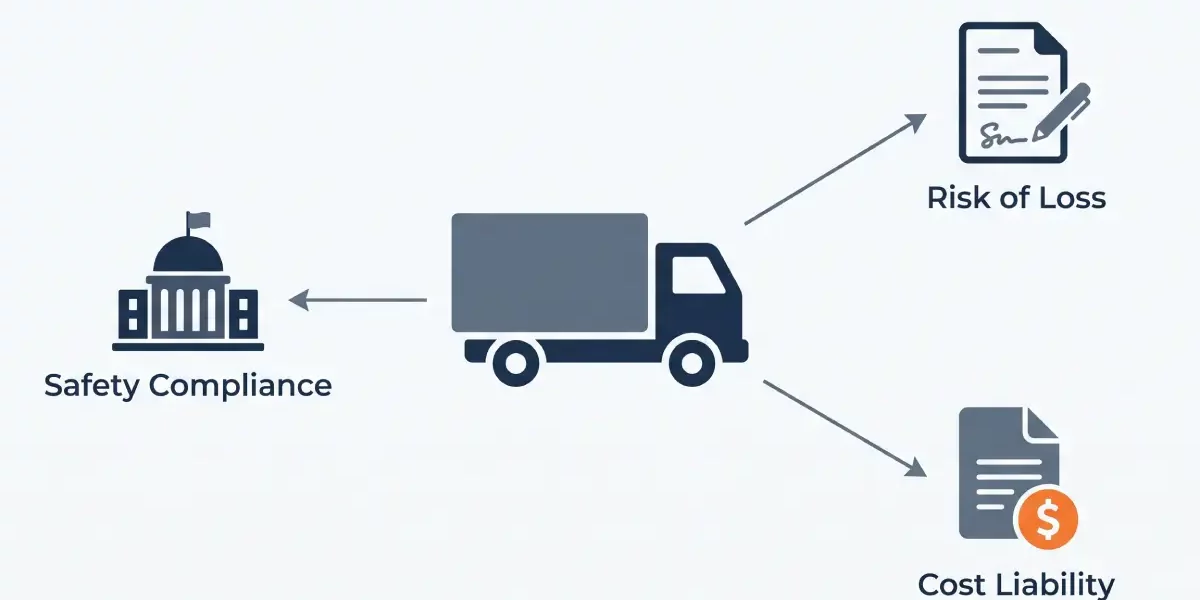
Quick Answer: No single party is responsible for transporting goods. Australian law splits the answer three ways. The Heavy Vehicle National Law shares safety accountability across ten supply chain functions and forbids delegating it. Contract terms, usually an Incoterms rule, decide who carries the risk of loss. The Australian Consumer Law makes the seller answer for a failed consumer delivery.
Key Takeaways
- The Heavy Vehicle National Law names ten Chain of Responsibility functions. Six of them belong to businesses that may never own or operate a truck.
- The Primary Duty cannot be transferred, delegated, or diluted. Subcontracting the transport does not remove it.
- Corporate maximums for a Category 1 breach now exceed $4.1 million, not the $3 million most sources still quote.
- The amended HVNL commenced 1 August 2026, adding mandatory Safety Management Systems for accredited operators.
- Under the C-terms (CPT, CIP, CFR, CIF) the seller pays the freight, but risk passes to the buyer at origin.
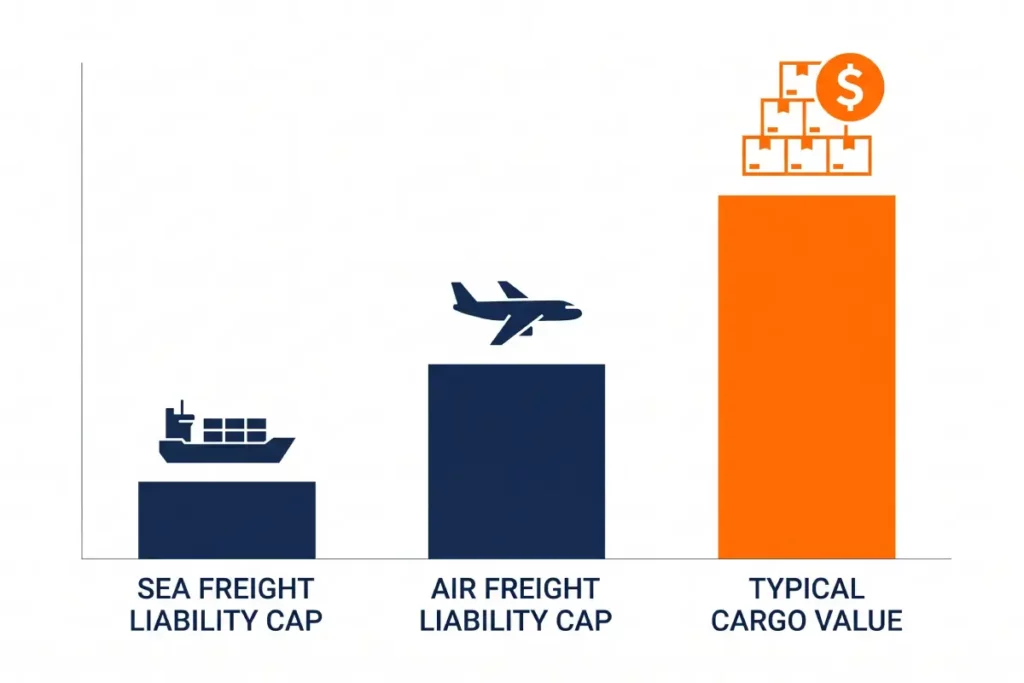
- Statutory carrier liability caps near 2 SDR per kilogram by sea and 26 SDR per kilogram by air, far below most cargo values.
- For consumer sales, the seller owns the remedy regardless of which courier caused the damage.
Figures current as at August 2026. HVNL penalties index each July.
- Why Does This Question Have Three Different Answers?
- Who Is Legally Accountable for Freight Safety in Australia?
- Which Businesses Count as Chain of Responsibility Parties?
- Why Is the Driver Usually Not a CoR Party?
- Can You Contract Out of the Primary Duty?
- How Much Are Chain of Responsibility Penalties in 2026?
- What Changed Under the HVNL on 1 August 2026?
- Do Executives Carry a Separate Legal Duty?
- Does the Chain of Responsibility Apply in WA and the NT?
- Who Carries the Risk If Goods Are Lost or Damaged?
- Why Don't Cost and Risk Transfer at the Same Point?
- Which Incoterms Should Never Be Used for Containers?
- How Much Will a Carrier Actually Pay for Damaged Freight?
- Who Is Responsible When an Online Order Arrives Damaged?
- How Do You Work Out Who Is Responsible for Your Shipment?
- Conclusion
Australian law names ten separate parties as responsible for the safe transport of goods, and the regulator states plainly that this responsibility cannot be transferred, delegated, or diluted by adding more parties to the chain.
That single fact breaks the most common assumption about freight: that responsibility sits with whoever is driving the truck.
The question hides three separate questions. One concerns safety accountability under road transport law. One concerns who carries the risk if cargo is lost or damaged. One concerns who ends up paying. Each has a different answer, governed by a different body of law.
The stakes differ too. A safety failure exposes a corporation to a maximum penalty above $4.1 million. A misread contract term leaves a buyer carrying an uninsured loss on goods they assumed the seller still owned. A consumer delivery gone wrong lands on the retailer, whichever courier dropped the box.
This article separates the three questions and answers each one. Working out who is responsible for your shipment starts with identifying which question you are actually asking.
Why Does This Question Have Three Different Answers?
Because “responsible” does three different jobs in freight. Safety accountability, risk of loss, and remedy each route to separate law, and a single shipment can produce a different answer to all three. A warehouse can be legally accountable for load safety while carrying no risk of loss and paying none of the freight.
Conflating the three causes most of the confusion in this area. The table below maps each question to the framework that answers it.
| If you’re asking | Governing framework | Who is responsible |
| Who answers to the regulator for load safety, mass, or fatigue? | Heavy Vehicle National Law, Chain of Responsibility | All ten CoR functions at once, non-transferable |
| Who absorbs the loss if cargo is damaged or stolen in transit? | Contract terms, usually Incoterms 2020 | Whichever party held risk at the moment of loss |
| Who compensates a consumer whose order arrives broken? | Australian Consumer Law | The seller, regardless of courier fault |
| Who pays the freight invoice? | Contract terms | As negotiated, often not the party holding risk |
Who Is Legally Accountable for Freight Safety in Australia?
Every party who can influence the outcome, simultaneously. Rather than assigning safety to one party, the Heavy Vehicle National Law gives the same Primary Duty to ten supply chain functions. Section 26C requires each party to ensure the safety of its transport activities so far as is reasonably practicable.
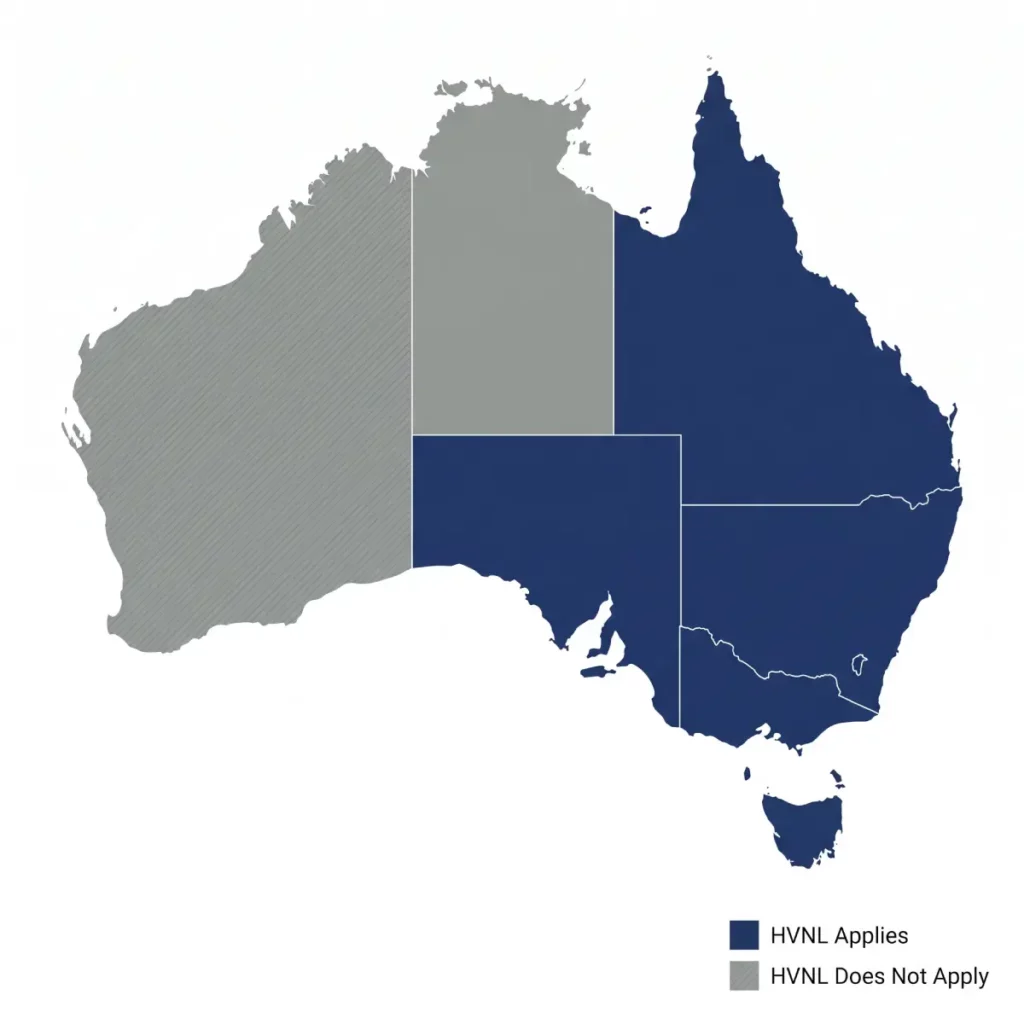
The National Heavy Vehicle Regulator administers the HVNL across the ACT, New South Wales, Queensland, South Australia, Tasmania, and Victoria. It covers vehicles over 4.5 tonnes gross vehicle mass. The regulator’s regulatory advice on the Primary Duty sets out how the obligation works in practice.
The duty runs to eliminating public risks, and where elimination is not reasonably practicable, to minimising them. It also prohibits causing or encouraging a driver to speed or breach the law, directly or indirectly.
Which Businesses Count as Chain of Responsibility Parties?
Any person or company performing one of ten functions listed in section 5 of the HVNL. Status comes from what you actually do, not from your job title, your contract wording, or whether you own a vehicle. Most businesses hold several functions at once without realising it.
| # | Function | Activity that triggers it |
| 1 | Employer | Employing a heavy vehicle driver |
| 2 | Prime contractor | Engaging a self-employed driver under a contract for services |
| 3 | Operator | Directing the control and use of a heavy vehicle |
| 4 | Scheduler | Scheduling transport, or a driver’s work and rest hours |
| 5 | Consignor | Coordinating and sending goods for transport |
| 6 | Consignee | Receiving goods delivered by a heavy vehicle |
| 7 | Packer | Packing or assembling goods for transport |
| 8 | Loading manager | Managing premises where five or more heavy vehicles load or unload daily |
| 9 | Loader | Loading a heavy vehicle |
| 10 | Unloader | Unloading a heavy vehicle |
Six of these ten functions belong to businesses that may never own or operate a truck. A retailer receiving pallets is a consignee. A factory packing cartons is a packer. A distribution centre handling five or more trucks a day is a loading manager.
In the NHVR’s own worked example of a routine delivery, three businesses hold nine functions between them. The ordering company is consignee, unloader, and loading manager. The supplying company is consignor, scheduler, packer, loader, and loading manager. The transport company is operator, employer, and scheduler.
Why Is the Driver Usually Not a CoR Party?
Because the 2018 reforms deliberately moved accountability upstream. A driver is only a CoR party if they are an owner-operator or perform one of the ten functions themselves. Drivers remain bound by other HVNL rules on speed, fatigue, and load restraint, but the Primary Duty sits with the parties who set the commercial terms.
Before the amendments, enforcement leaned heavily on drivers, who often had the least control over the pressures producing unsafe outcomes.
The reform shifted the focus to whoever set the schedule, packed the load, and signed the contract.
Can You Contract Out of the Primary Duty?
No. The HVNL states the Primary Duty cannot be transferred or delegated, and it is not diminished by the number of parties involved. Subcontracting your transport does not remove your status as a CoR party. Assuming another party has it covered is not a defence.
Three principles do most of the work here.
Section 26A: shared responsibility. Safety of transport activities is the shared responsibility of each party in the chain. Courts do not carve the task into slices and assign one slice per party.
Section 26B: no dilution. Where several parties hold the Primary Duty for the same activity, the duty is not diminished. Adding parties does not divide the obligation, and each must independently meet the same standard.
No delegation. The NHVR confirms parties remain CoR parties even when their transport activities are contracted or subcontracted out.
Regulator guidance goes further. It states it is not sufficient to assume other parties are meeting their duty, and that you need to understand how risks are managed at every stage of the journey you can influence.
The NHVR’s first prosecution of a consignor under the 2018 amendments makes this concrete. It concerned a shipping container of imported plywood that rolled over in suburban Melbourne, with alleged failures including no restraint system inside the container, not telling the overseas supplier about Australian safety requirements, and not advising the driver how the load was packed.
None of those alleged failures happened on a road. All of them sat with a party that was not driving.
How Much Are Chain of Responsibility Penalties in 2026?
More than most published figures suggest. Nearly every source still quotes $300,000 for an individual and $3 million for a corporation. Those were the 2018 statutory base figures. HVNL penalties index every July with CPI, and current Category 1 maximums sit above $424,794 and $4.1 million.
| Category | Conduct | Individual (2018 base) | Corporation (2018 base) |
| 1 | Reckless breach exposing someone to risk of death or serious injury | $300,000 and/or 5 years imprisonment | $3,000,000 |
| 2 | Same risk exposure, without recklessness | $150,000 | $1,500,000 |
| 3 | Breach of the duty, no proven exposure to that risk | $50,000 | $500,000 |
The NHVR’s published Category 1 maximums, accurate as at 1 July 2025, are more than $424,794 or five years imprisonment for an individual, and more than $4,113,837 for a corporation. A further July indexation has since applied, so current figures sit above those numbers.
Real outcomes already reach seven figures. In November 2023, a court fined a transport company $2.31 million and prohibited it from operating for 12 months over a fatigue-related CoR breach, and separately fined its managing director $22,000 with a supervisory order.
That personal fine matters more than its size suggests, because it attached to an executive under a separate duty.
What Changed Under the HVNL on 1 August 2026?
The Heavy Vehicle National Law Amendment Act commenced on 1 August 2026 across participating jurisdictions, following the most substantial review since the law began in 2014. Three changes affect how responsibility gets assessed: mandatory Safety Management Systems, a new evidentiary benchmark, and a tightened unfit-to-drive provision.
Safety Management Systems became a condition of accreditation. Enrolment in heavy vehicle accreditation now depends on an operator holding a documented SMS, supported by a new SMS Standard and National Audit Standard released in May 2026.
The 2026 Master Code became the practical benchmark. Released in January 2026, it contains more than 500 controls across 45 transport activities. No single business would apply all of them.
The Master Code is not itself enforceable. No offence exists for failing to implement an individual control, and no business can be prosecuted for failing to comply with the Code. Its weight is evidentiary, demonstrating what a party or executive knew or ought to have known about relevant hazards and controls.
Section 26E tightened. It now prohibits requests or contracts that would result in a driver operating a heavy vehicle while unfit to drive. A scheduler booking a run that only works if the driver pushes through exhaustion has a specific provision to answer to.
Do Executives Carry a Separate Legal Duty?
Yes. Section 26D requires an executive of a CoR business to exercise due diligence to ensure the business complies with its Primary Duty. This duty is personal and independent of the company’s, and the maximum penalties mirror those for an individual breaching the Primary Duty.
Due diligence is not satisfied by delegation to a compliance manager. It requires the executive to understand the operation’s risks, verify that resources and systems exist, and confirm those systems work.
The scope reaches further than most boards expect. Board decisions, organisational structure, recruitment strategy, premises layout, and contract terms all sit inside the transport activities the NHVR examines.
Procurement and maintenance decisions do too, which is where fleet cost modelling and safety accountability intersect. Our guide to calculating the true lifetime cost of fleet assets covers the maintenance side of that equation.
Does the Chain of Responsibility Apply in WA and the NT?
Not directly, and this creates a trap for interstate operators. Neither jurisdiction has adopted the HVNL. Western Australia imposes comparable obligations under its own road traffic legislation, while the Northern Territory has no dedicated CoR regime. The HVNL applies to vehicles from the moment they cross into a participating state.
Western Australia’s obligations on supply chain parties sit in the Road Traffic (Administration) Act 2008 and the Road Traffic (Vehicle) Act 2012.
Northern Territory parties, including employers, can still be liable for breaches of road and load laws despite the absence of a specific CoR framework.
In some cases, compliance obligations bite before the border. Fatigue work diary requirements are the standard example.
Long-haul relocations cross these boundaries as a matter of routine. A Melbourne to Perth run, one of the standard lanes for specialist movers such as Interstate Caravan Transport, begins under the HVNL and finishes under Western Australian legislation, so compliance planning has to cover the whole route rather than the origin state.
Who Carries the Risk If Goods Are Lost or Damaged?
Whoever the contract says, at the precise moment the contract specifies. Safety accountability tells you nothing about who absorbs a loss. In international trade, an Incoterms rule usually answers it, fixing the exact point where risk of loss or damage passes from seller to buyer.
Incoterms are eleven three-letter rules published by the International Chamber of Commerce. The current edition, Incoterms 2020, took effect on 1 January 2020.
The ICC splits the eleven into two families. Seven work for any transport mode, including road, rail, air, sea, and multimodal: EXW, FCA, CPT, CIP, DAP, DPU, and DDP. Four apply only to sea and inland waterway carriage: FAS, FOB, CFR, and CIF.
Every rule needs a named place or port to function. “FOB” alone settles nothing. “FOB Melbourne (Incoterms 2020)” settles a great deal.
Incoterms also have limits. They do not transfer ownership, set payment terms, or determine which law governs the contract. They sit alongside those provisions rather than replacing them.
Incoterms 2020 Risk Transfer Compared
| Rule | Transport mode | Risk passes to buyer at | Main carriage paid by | Import clearance |
| EXW | Any mode | Seller’s premises, before loading | Buyer | Buyer |
| FCA | Any mode | Handover to buyer’s nominated carrier | Buyer | Buyer |
| CPT | Any mode | Handover to first carrier (origin) | Seller | Buyer |
| CIP | Any mode | Handover to first carrier (origin) | Seller, plus ICC A insurance | Buyer |
| DAP | Any mode | Arrival at named place, ready for unloading | Seller | Buyer |
| DPU | Any mode | Arrival and unloading at named place | Seller | Buyer |
| DDP | Any mode | Arrival at named place, ready for unloading | Seller | Seller |
| FAS | Sea, inland waterway | Alongside the vessel at load port | Buyer | Buyer |
| FOB | Sea, inland waterway | On board the vessel at load port | Buyer | Buyer |
| CFR | Sea, inland waterway | On board the vessel at load port | Seller | Buyer |
| CIF | Sea, inland waterway | On board the vessel at load port | Seller, plus ICC C insurance | Buyer |
Seller obligation runs lowest to highest in this order: EXW, FCA, FAS, FOB, then CFR and CPT, then CIF and CIP, then DAP, DPU, and DDP. Export clearance sits with the seller under every rule except EXW.
Why Don’t Cost and Risk Transfer at the Same Point?
Because the four C-terms deliberately separate them. Under CPT, CIP, CFR, and CIF the seller pays freight through to destination, but risk passes to the buyer at origin the moment goods reach the first carrier or go on board. This is the most expensive misunderstanding in the set.
A buyer on CIF terms whose cargo sinks mid-voyage carries that loss, despite the seller having paid the ocean freight and arranged the insurance.
Seeing the seller’s name on the freight invoice tells you nothing about who owned the risk when the water came in.
Insurance minimums also differ between the two C-terms requiring cover. Incoterms 2020 lifted CIP to Institute Cargo Clauses A, the broadest standard cover, while CIF stayed at Clauses C, the narrowest.
Which Incoterms Should Never Be Used for Containers?
FOB, CFR, and CIF. All three assume risk passes at the ship’s rail, which suits break-bulk cargo loaded directly aboard. Containers are handed over at an inland depot days earlier, leaving an uncovered gap between actual handover and contractual risk transfer.
The ICC recommends FCA for container shipments, and FCA, CPT, CIP, DAP, DPU, or DDP for air and multimodal transport.
Using FOB for a container remains one of the most common errors in the trade. It survives because FOB is habitual, not because it fits.
How Much Will a Carrier Actually Pay for Damaged Freight?
Far less than the cargo is worth. “The carrier is responsible” is technically true and practically misleading, because statutory liability caps sit well below the value of most freight. Sea carriage caps near 2 SDR per kilogram. International air caps at 26 SDR per kilogram.
| Mode | Governing rules | Statutory cap | Approx. per kg |
| Sea, outbound from Australia | Amended Hague Rules, Carriage of Goods by Sea Act 1991 (Cth) | 666.67 SDR per package or unit, or 2 SDR per kg, whichever is higher | ~US$2.60 |
| International air | Montreal Convention, from 28 December 2024 | 26 SDR per kg | ~US$34 |
Special Drawing Rights are an International Monetary Fund unit of account, worth roughly US$1.33 in late 2024. Conversions above use that rate, and SDR floats against all currencies.
The air limit rose from 22 SDR following ICAO’s five-yearly inflation review, which set the adjustment at 17.9 per cent. The original 1999 limit was 17 SDR, raised to 19 in 2009 and 22 in 2019.
Air freight therefore compensates at more than ten times the sea rate per kilogram. Neither figure comes close to covering high-value cargo.
Two mechanisms close the gap. Declaring the nature and value of the goods before shipment, with that declaration in the bill of lading, lifts the sea cap. Cargo insurance covers physical loss without requiring proof that the carrier was negligent, which matters because the shipper bears that burden and it is often difficult to discharge.
Time limits are unforgiving. Under the amended Hague Rules the carrier is discharged from all liability unless suit is brought within one year of delivery, or of the date the goods should have been delivered.
Who Is Responsible When an Online Order Arrives Damaged?
The seller. Under the Australian Consumer Law, businesses guarantee the goods they sell are of acceptable quality. A product delivered with a cracked screen fails that guarantee regardless of which courier caused the damage, and the business must resolve the claim with the courier itself.
A retailer cannot redirect a consumer to the manufacturer or the carrier to pursue the remedy themselves.
Where goods never arrive, and the business fails to supply them, the consumer is entitled to a refund of what they paid.
Remedies scale with severity. A major failure lets the consumer choose between refund and replacement. A minor one lets the business elect to repair.
Store policies cannot override these rights. A returns policy disclaiming responsibility for transit damage has no effect against the ACL.
One exception matters for businesses. Section 63 of the ACL excludes consumer guarantees from contracts for transporting or storing goods for business purposes. A sole trader ordering tools for their trade and paintbrushes for a hobby has guarantee protection against the courier for one and not the other.
How Do You Work Out Who Is Responsible for Your Shipment?
Work through the three frameworks in order, starting with the question you actually need answered. Each step below routes to different law, so answering the wrong one wastes time.
- Name the question. Decide whether you need safety accountability, risk of loss, or remedy. These route to the HVNL, your contract, and the ACL respectively.
- Audit your CoR functions. List every activity your business performs against the ten functions in section 5. Do this by activity, not by job title or contract wording, because function creates the duty.
- Find the Incoterms rule. Confirm the contract names a specific place and cites the 2020 edition. Check the rule’s family matches the transport mode, since a sea-only rule on a containerised or air shipment signals an uncovered gap.
- Compare the cap to the cargo value. Calculate the statutory liability limit against what your freight is actually worth before assuming the carrier will make you whole.
- Close the gap. Where the shortfall is material, either declare value in the transport document or arrange cargo insurance.
- For consumer sales, act first and recover second. Treat transit damage as your problem to solve, then pursue the carrier separately. The consumer’s remedy does not wait on your claim.
Where liability is contested, or the amounts are significant, get advice from a lawyer working in transport or trade law. This article explains how the frameworks allocate responsibility. It is not legal advice about your situation.
Conclusion
No single party is responsible for the transportation of goods, and any answer naming one is answering a narrower question than the one asked.
The honest answer is that it depends on which of three questions you mean. Safety accountability under the Heavy Vehicle National Law is shared across ten functions, cannot be transferred or delegated, and is not diluted by the number of parties involved. Risk of loss is set by contract, most often by an Incoterms rule, and passes at a point that frequently differs from where cost transfers. Remedy for a failed consumer delivery sits with the seller, whatever the courier did.
The practical takeaway follows from that split. Identify every Chain of Responsibility function your business performs, because you hold them whether or not you own a truck and whether or not you subcontracted the work. Read the Incoterms rule for its risk transfer point rather than its freight arrangement, and check the rule suits your transport mode. Compare the statutory liability cap against your cargo value before relying on the carrier.
The parties facing the largest exposure are usually the ones who assumed the question had a single answer.